
Enhancing Task Completion Efficiency Through Grid View Actions in MIDAP
Client Overview
One of our clients manages multiple operational workflows using MI Digital Autopilot (MIDAP), where tasks are assigned to individual users for execution and completion. These workflows are critical to the organization’s day-to-day operations and require continuous monitoring to ensure activities are completed on time.
To maintain process efficiency, a Process Coordinator (PC) oversees workflow execution, tracks task progress, follows up on pending activities, and ensures that business processes move forward without delays. The organization relies on MIDAP’s Flow Management System (FMS) to provide visibility into task status, ownership, and workflow progression.
As the volume of operational tasks increased, the client identified a need for greater flexibility in managing task completion and reducing dependency on individual users for updating task statuses.
Business Challenge
In the existing process, tasks could only be marked as completed by the users to whom they were assigned. While this approach maintained accountability, it also created operational challenges in situations where assigned users were unable to update their task status on time, despite the work already being completed.
As a result, completed activities often continued to appear as pending within the system, preventing workflows from progressing smoothly. Since many business processes depend on timely task completion, these delays created unnecessary bottlenecks and increased the workload of Process Coordinators.
Although Process Coordinators had complete visibility into task statuses through the FMS Grid View, they lacked the ability to take action and complete tasks directly. Even after verifying that an activity had been completed, they still had to wait for the assigned user to update the task status.
This dependency led to delays in workflow execution, increased follow-up efforts, and reduced overall operational efficiency.
Key Challenges
The client faced several operational challenges:
- Dependency on assigned users to complete and update task statuses.
- Delays in task closure despite the actual work being completed.
- Increased follow-up effort for Process Coordinators.
- Workflow bottlenecks caused by pending tasks.
- Limited action capability within the FMS Grid View despite having full visibility.
- Reduced efficiency in managing day-to-day operational activities.
- Additional administrative effort required to ensure workflow continuity.
Why the Existing Process Needed Improvement
The FMS Grid View provided Process Coordinators with a centralized view of all ongoing tasks, helping them monitor workflow progress and identify pending activities quickly.
However, visibility alone was not enough.
In many cases, the coordinator could verify that a task had already been completed through communication with team members or related workflow activities. Despite having this information, they were unable to update the task status themselves.
This created a situation where operational progress depended not on whether the work had been completed, but on whether the assigned user had updated the system.
The client wanted a solution that would provide Process Coordinators with greater control while maintaining existing access permissions and workflow governance.
Project Objectives
The primary objectives of the enhancement were:
- Enable Process Coordinators to complete tasks directly when required.
- Reduce dependency on assigned users for task closure.
- Improve workflow efficiency and turnaround times.
- Minimize delays caused by pending task updates.
- Provide actionable controls within the FMS Grid View.
- Simplify task management and follow-up processes.
- Improve overall productivity and operational responsiveness.
Solution Implemented
To address these challenges, MIDAP (MI Digital Autopilot) introduced a custom enhancement within the Flow Management System (FMS).
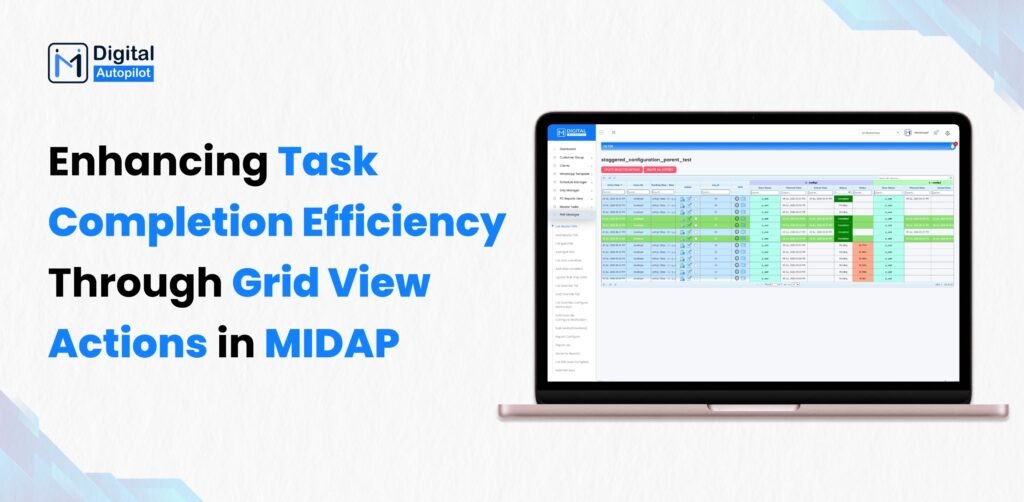
A dedicated “Complete” action button was added directly to the FMS Grid View, allowing authorized users to mark tasks as completed without opening individual task records.
This enhancement enables Process Coordinators and other authorized users to take immediate action when they have confirmed that the required work has been completed.
The solution was designed to maintain existing workflow controls and access permissions while providing greater operational flexibility.
By bringing task completion functionality directly into the Grid View, MIDAP eliminated unnecessary navigation and reduced the dependency on assigned users for updating task statuses.
Key Features Implemented
1. Direct Task Completion from Grid View
A dedicated “Complete” button was added to the FMS Grid View, allowing authorized users to complete tasks directly from the listing screen.
This eliminates the need to open individual task records, saving time and simplifying task management.
2. Permission-Based Access Control
The feature is available only to users who have the required access rights and permissions.
This ensures that task completion authority remains controlled while allowing designated users to take action when necessary.
3. Faster Workflow Progression
Process Coordinators can now immediately complete eligible tasks after verifying that the associated work has been finished.
This prevents unnecessary delays and helps workflows progress more efficiently.
4. Reduced Administrative Effort
The enhancement minimizes repetitive follow-up communication between coordinators and assigned users.
Instead of waiting for status updates, authorized users can take action directly within the system.
5. Improved User Experience
The ability to complete tasks from the Grid View reduces navigation effort and simplifies daily workflow management.
Users can manage larger volumes of tasks more efficiently from a single interface.
Custom Development Approach
This requirement was fulfilled through custom development within MIDAP.
The FMS Grid View was enhanced with a task-level action button capable of triggering task completion directly from the listing page. The implementation was carefully designed to preserve existing workflow logic, user permissions, and system integrity while providing the additional flexibility requested by the client.
The enhancement seamlessly integrates into the existing user experience, requiring minimal training and enabling immediate adoption by operational teams.
Results & Benefits
Reduced Dependency on Assigned Users
Process Coordinators no longer need to rely solely on assigned users to update task statuses. Authorized personnel can now ensure tasks are completed within the system when appropriate, reducing operational dependency.
Faster Task Closure
Tasks can be closed as soon as completion has been verified, eliminating delays caused by pending status updates and improving workflow continuity.
Improved Workflow Efficiency
By removing unnecessary bottlenecks, workflows move forward more smoothly and dependent activities can begin without waiting for administrative updates.
Lower Follow-Up Effort
The enhancement significantly reduces the need for repeated reminders and follow-up communication, allowing coordinators to focus on higher-value operational activities.
Better Operational Control
Authorized users now have greater control over task management and can proactively address pending activities before they impact workflow performance.
Enhanced Productivity
Completing tasks directly from the Grid View reduces clicks, navigation time, and manual effort, enabling teams to manage larger workloads more efficiently.
Improved User Experience
The streamlined process provides a faster and more intuitive way to manage tasks, contributing to a better overall experience for operational teams.
Business Impact
The enhancement delivered measurable operational improvements by:
- Reducing workflow delays caused by pending task updates.
- Improving Process Coordinator efficiency.
- Minimizing administrative overhead.
- Accelerating workflow execution.
- Increasing responsiveness in task management.
- Strengthening operational control and visibility.
- Supporting faster decision-making and process completion.
Conclusion
Operational efficiency often depends on removing small but critical process bottlenecks. By introducing a “Complete” action directly within the MIDAP FMS Grid View, the client gained greater flexibility, control, and efficiency in managing daily workflows.
The enhancement empowered Process Coordinators to take timely action, reduce dependency on assigned users, and ensure workflows progressed without unnecessary delays. As a result, the organization achieved faster task closure, improved productivity, and a more streamlined operational process.
This custom development demonstrates MIDAP’s ability to adapt to unique business requirements and deliver practical automation solutions that help organizations build more efficient, system-driven operations.
Client Overview
One of our clients manages multiple operational workflows using MI Digital Autopilot (MIDAP), where tasks are assigned to individual users for execution and completion. These workflows are critical to the organization’s day-to-day operations and require continuous monitoring to ensure activities are completed on time.
To maintain process efficiency, a Process Coordinator (PC) oversees workflow execution, tracks task progress, follows up on pending activities, and ensures that business processes move forward without delays. The organization relies on MIDAP’s Flow Management System (FMS) to provide visibility into task status, ownership, and workflow progression.
As the volume of operational tasks increased, the client identified a need for greater flexibility in managing task completion and reducing dependency on individual users for updating task statuses.
Business Challenge
In the existing process, tasks could only be marked as completed by the users to whom they were assigned. While this approach maintained accountability, it also created operational challenges in situations where assigned users were unable to update their task status on time, despite the work already being completed.
As a result, completed activities often continued to appear as pending within the system, preventing workflows from progressing smoothly. Since many business processes depend on timely task completion, these delays created unnecessary bottlenecks and increased the workload of Process Coordinators.
Although Process Coordinators had complete visibility into task statuses through the FMS Grid View, they lacked the ability to take action and complete tasks directly. Even after verifying that an activity had been completed, they still had to wait for the assigned user to update the task status.
This dependency led to delays in workflow execution, increased follow-up efforts, and reduced overall operational efficiency.
Key Challenges
The client faced several operational challenges:
- Dependency on assigned users to complete and update task statuses.
- Delays in task closure despite the actual work being completed.
- Increased follow-up effort for Process Coordinators.
- Workflow bottlenecks caused by pending tasks.
- Limited action capability within the FMS Grid View despite having full visibility.
- Reduced efficiency in managing day-to-day operational activities.
- Additional administrative effort required to ensure workflow continuity.
Why the Existing Process Needed Improvement
The FMS Grid View provided Process Coordinators with a centralized view of all ongoing tasks, helping them monitor workflow progress and identify pending activities quickly.
However, visibility alone was not enough.
In many cases, the coordinator could verify that a task had already been completed through communication with team members or related workflow activities. Despite having this information, they were unable to update the task status themselves.
This created a situation where operational progress depended not on whether the work had been completed, but on whether the assigned user had updated the system.
The client wanted a solution that would provide Process Coordinators with greater control while maintaining existing access permissions and workflow governance.
Project Objectives
The primary objectives of the enhancement were:
- Enable Process Coordinators to complete tasks directly when required.
- Reduce dependency on assigned users for task closure.
- Improve workflow efficiency and turnaround times.
- Minimize delays caused by pending task updates.
- Provide actionable controls within the FMS Grid View.
- Simplify task management and follow-up processes.
- Improve overall productivity and operational responsiveness.
Solution Implemented
To address these challenges, MIDAP introduced a custom enhancement within the Flow Management System (FMS).
A dedicated “Complete” action button was added directly to the FMS Grid View, allowing authorized users to mark tasks as completed without opening individual task records.
This enhancement enables Process Coordinators and other authorized users to take immediate action when they have confirmed that the required work has been completed.
The solution was designed to maintain existing workflow controls and access permissions while providing greater operational flexibility.
By bringing task completion functionality directly into the Grid View, MIDAP eliminated unnecessary navigation and reduced the dependency on assigned users for updating task statuses.
Key Features Implemented
1. Direct Task Completion from Grid View
A dedicated “Complete” button was added to the FMS Grid View, allowing authorized users to complete tasks directly from the listing screen.
This eliminates the need to open individual task records, saving time and simplifying task management.
2. Permission-Based Access Control
The feature is available only to users who have the required access rights and permissions.
This ensures that task completion authority remains controlled while allowing designated users to take action when necessary.
3. Faster Workflow Progression
Process Coordinators can now immediately complete eligible tasks after verifying that the associated work has been finished.
This prevents unnecessary delays and helps workflows progress more efficiently.
4. Reduced Administrative Effort
The enhancement minimizes repetitive follow-up communication between coordinators and assigned users.
Instead of waiting for status updates, authorized users can take action directly within the system.
5. Improved User Experience
The ability to complete tasks from the Grid View reduces navigation effort and simplifies daily workflow management.
Users can manage larger volumes of tasks more efficiently from a single interface.
Custom Development Approach
This requirement was fulfilled through custom development within MIDAP.
The FMS Grid View was enhanced with a task-level action button capable of triggering task completion directly from the listing page. The implementation was carefully designed to preserve existing workflow logic, user permissions, and system integrity while providing the additional flexibility requested by the client.
The enhancement seamlessly integrates into the existing user experience, requiring minimal training and enabling immediate adoption by operational teams.
Results & Benefits
Reduced Dependency on Assigned Users
Process Coordinators no longer need to rely solely on assigned users to update task statuses. Authorized personnel can now ensure tasks are completed within the system when appropriate, reducing operational dependency.
Faster Task Closure
Tasks can be closed as soon as completion has been verified, eliminating delays caused by pending status updates and improving workflow continuity.
Improved Workflow Efficiency
By removing unnecessary bottlenecks, workflows move forward more smoothly and dependent activities can begin without waiting for administrative updates.
Lower Follow-Up Effort
The enhancement significantly reduces the need for repeated reminders and follow-up communication, allowing coordinators to focus on higher-value operational activities.
Better Operational Control
Authorized users now have greater control over task management and can proactively address pending activities before they impact workflow performance.
Enhanced Productivity
Completing tasks directly from the Grid View reduces clicks, navigation time, and manual effort, enabling teams to manage larger workloads more efficiently.
Improved User Experience
The streamlined process provides a faster and more intuitive way to manage tasks, contributing to a better overall experience for operational teams.
Business Impact
The enhancement delivered measurable operational improvements by:
- Reducing workflow delays caused by pending task updates.
- Improving Process Coordinator efficiency.
- Minimizing administrative overhead.
- Accelerating workflow execution.
- Increasing responsiveness in task management.
- Strengthening operational control and visibility.
- Supporting faster decision-making and process completion.
Conclusion
Operational efficiency often depends on removing small but critical process bottlenecks. By introducing a “Complete” action directly within the MIDAP FMS Grid View, the client gained greater flexibility, control, and efficiency in managing daily workflows.
The enhancement empowered Process Coordinators to take timely action, reduce dependency on assigned users, and ensure workflows progressed without unnecessary delays. As a result, the organization achieved faster task closure, improved productivity, and a more streamlined operational process.
This custom development demonstrates MIDAP’s ability to adapt to unique business requirements and deliver practical automation solutions that help organizations build more efficient, system-driven operations.