Centralized Inventory Management for Rajan Wadhwa
Client Overview
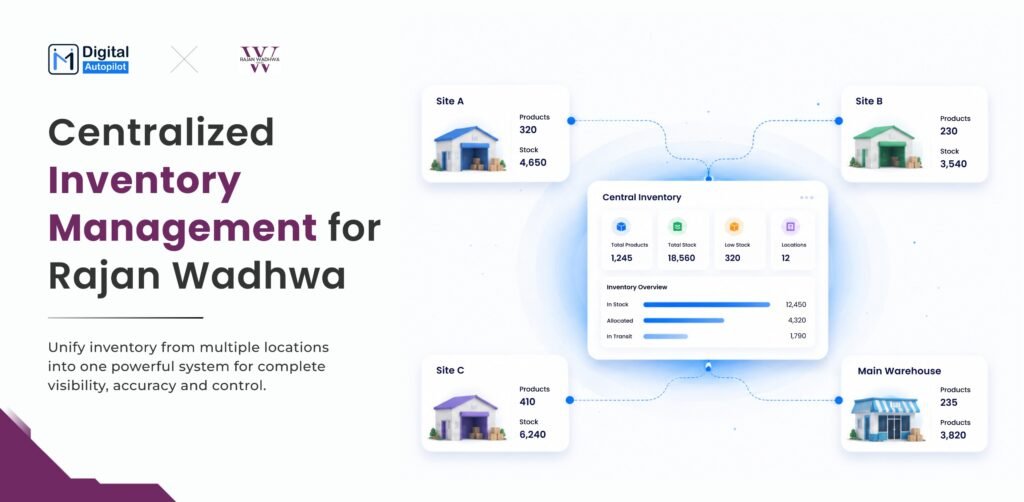
Rajan Wadhwa manages multiple project sites across different locations, with each site operating independently for day-to-day inventory activities. Locations such as Sainik Vihar, Engineers Enclave, and Pitampura maintain their own stock of construction materials, equipment, and consumables. Although the inventory belongs to different sites, the client wanted to monitor and manage everything through a single centralized system.
As the business expanded, maintaining accurate inventory records across multiple locations became increasingly important. The client required a solution that could track inward and outward movements for every site while avoiding duplicate systems and unnecessary software licensing costs.
Business Challenge
The client initially considered creating a separate Flow Management System (FMS) for every project site. This would have allowed each location to maintain its own warehouse and inventory records independently.
However, this approach was not practical. Since every FMS deployment required a separate license, managing multiple project sites through independent systems would significantly increase implementation and maintenance costs. It would also make reporting across all locations more difficult.
To overcome this limitation, the client decided to operate all project sites through a FMS.
While this solved the licensing challenge, it introduced a new operational problem.
Within the same system, multiple warehouses now existed—one for each project site. Since the same material or SKU could be available in more than one warehouse, users performing inward or outward transactions often faced confusion about which warehouse should be updated.
For example, if a user issued cement bags from one Site but accidentally recorded the transaction against another Warehouse, the inventory would become inaccurate for both locations. Even a small data entry mistake could affect stock availability, purchase planning, and inventory reports.
The client needed a solution that could eliminate this ambiguity while continuing to use a single FMS deployment.
MIDAP Solution
MIDAP (MI Digital Autopilot) designed a centralized multi-warehouse inventory management solution that allowed every project site to operate independently while remaining part of the same Flow Management System.
Instead of creating multiple FMS instances, separate warehouses were configured within one system. Each warehouse represented an individual project location.
For example:
- Sainik Vihar Warehouse
- Pitampura Warehouse
- Engineers Enclave Warehouse
This approach enabled the client to manage all project sites from a single platform without purchasing additional FMS.
To ensure that inventory transactions were always recorded against the correct location, MIDAP introduced a mandatory Warehouse field in the inventory forms. Before any inward or outward transaction could be submitted, users had to select the warehouse where the inventory movement was taking place.
Once a warehouse was selected, the system used conditional logic within the FMS Connector to determine where the transaction should be processed. Every stock update was automatically linked to the selected warehouse, ensuring that inventory remained isolated for each project site.
To further reduce user errors, MIDAP implemented contextual field behaviour within the forms.
The available SKU list changes dynamically based on the selected warehouse, allowing users to work only with products that belong to that location. Quantity updates and inventory validations are also performed within the context of the selected warehouse, preventing accidental updates to stock maintained at another site.
This combination of mandatory warehouse selection and intelligent conditional logic ensured that every inventory transaction was processed accurately without requiring users to manually verify warehouse mappings.
How the Solution Works
The inventory workflow follows a simple but controlled process.
- A site supervisor initiates an inward or outward inventory transaction via picture.
- The appropriate project warehouse is selected by the process coordinator.
- Based on the selected warehouse, the system displays the relevant inventory items.
- Users record the product and quantity being moved.
- The FMS Connector automatically updates inventory only for the selected warehouse.
- Inventory records for other project sites remain completely unaffected.
- Every transaction is reflected immediately in IMS Reports, providing up-to-date stock information for each location with actual consumption data.
This workflow ensures that inventory movements are always associated with the correct project site while allowing the client to manage all locations from a single system.
Business Impact
The implementation enabled Rajan Wadhwa Estates to centralize inventory operations without compromising warehouse-level accuracy.
The solution delivered several operational improvements:
- Managed multiple project sites through a FMS.
- Eliminated the need to purchase separate FMS for every location.
- Ensured warehouse-specific inward and outward inventory tracking.
- Prevented inventory updates from affecting the wrong warehouse.
- Reduced manual errors during stock transactions.
- Improved inventory accuracy across all project locations.
- Simplified data entry through warehouse-based SKU filtering.
- Enabled centralized IMS reporting while maintaining independent warehouse records.
- Created a scalable system that can easily accommodate additional project sites in the future.
Conclusion
By configuring multiple warehouses within a single Flow Management System, MIDAP helped Rajan Wadhwa Estates overcome the limitations of managing inventory across multiple project sites. The solution provides centralized control while preserving warehouse-level accuracy for every inventory transaction.
Today, the client can manage inward and outward movements across all project locations from one system, with each transaction automatically updating the correct site warehouse. The implementation not only reduced software licensing costs but also improved inventory accuracy, simplified daily operations, and created a scalable foundation for future expansion.