
Automated Delivery Performance & Target Tracking
About the Client
Gokul manages multiple Delivery Boys who handle orders received through platforms such as Swiggy and Zomato. Since the number of orders can vary from day to day and from one Delivery Boy to another, the management team needed a better way to track individual performance.
The client wanted to move away from manual calculations and maintain a structured system where order volume, processing time, and weekly order-value targets could be monitored together.
Business Requirement
The client had defined a standard processing target of 2 minutes per order.
However, the total target time could not be fixed because every Delivery Boy might handle a different number of orders.
For example:
- 10 orders = 20 minutes target
- 20 orders = 40 minutes target
- 30 orders = 60 minutes target
The client therefore needed a system that could automatically calculate the target time based on the actual number of orders handled.
Along with processing time, management also wanted to track the following metrics for each Delivery Boy:
- Total Orders Handled
- Total Target Time
- Total Actual Time Taken
- Average Time per Order
- Weekly Order Value Target
- Actual Order Value Achieved
- Target Achievement Percentage
The main objective was to create a single workflow where these calculations could happen automatically instead of depending on manual MIS preparation.
Challenges with Manual Tracking
When performance calculations are handled manually, the team has to collect order information, calculate target time, calculate actual time, work out the average, and then compare the results with the weekly target.
As the number of Delivery Boys and daily orders increases, this can make regular performance monitoring more time-consuming.
The client needed a system where the required calculations would be generated automatically from the workflow data.
Our Solution
We automated the Delivery Performance and Target Tracking workflow using MIDAP(MI Digital Autopilot).
A standard target of 2 minutes per order was configured in the workflow. Based on the number of orders handled by a Delivery Boy, MIDAP automatically calculates the corresponding target time.
Dynamic Target Time Calculation
For example, if a Delivery Boy handles 20 orders:
20 Orders × 2 Minutes = 40 Minutes Target Time
The target is therefore calculated according to the actual order volume rather than using a fixed value.
This makes the performance comparison more relevant because each Delivery Boy is evaluated based on the number of orders handled.
Actual Time vs. Target Time
The workflow also captures the actual time taken to complete the orders.
The system can then compare the actual time with the calculated target time.
For example:
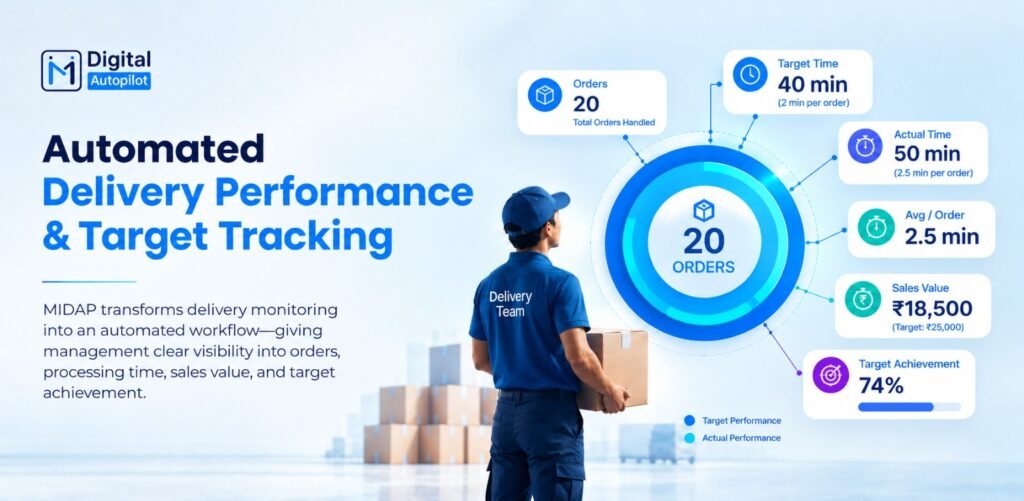
- Total Orders: 20
- Target Time: 40 Minutes
- Actual Time Taken: 50 Minutes
- Average Time per Order: 2.5 Minutes
In this example, the standard target is 2 minutes per order, while the actual average is 2.5 minutes.
This gives management a simple way to identify whether the Delivery Boy is completing orders within the expected processing time.
Automated Average Time Calculation
Instead of manually calculating the average time for every Delivery Boy, the system calculates it automatically using the order and time data available in the workflow.
For example:
50 Minutes Actual Time ÷ 20 Orders = 2.5 Minutes per Order
This helps management review individual performance without preparing separate calculations.
Weekly Order Value Target Tracking
The client also wanted to track performance based on order value, not just processing time.
A weekly order-value target can be defined for each Delivery Boy.
For example, if the weekly target is ₹25,000, MIDAP captures the actual order value achieved and calculates the corresponding target achievement percentage.
This allows the management team to look at two important areas together:
Operational Performance
How efficiently are the orders being handled?
Target Performance
How much of the weekly order-value target has been achieved?
By bringing these metrics into the same workflow, management gets a more complete view of Delivery Boy performance.
Consolidated Performance Reporting
The complete workflow brings the key performance information into a structured report.
Management can review:
- Order volume handled by each Delivery Boy
- Target time based on order volume
- Actual time taken
- Average processing time per order
- Weekly order-value target
- Actual order value achieved
- Target achievement percentage
Instead of checking different calculations separately, the required information can be reviewed from a consolidated performance view.
Business Impact
1. Automated Delivery Performance Tracking
Delivery Boy-wise order and performance data is captured and calculated through the workflow, reducing the need for repetitive manual tracking.
2. Dynamic Target Time Calculation
The system automatically calculates the expected processing time based on the number of orders handled.
3. Clear Target vs. Actual Visibility
Management can compare the expected target time with the actual time taken to understand delivery processing performance.
4. Automated Average Time Calculation
Average processing time per order is calculated automatically, making individual performance review easier.
5. Weekly Order Value Monitoring
Weekly order-value targets can be defined and compared with the actual order value achieved.
6. Automated Target Achievement Calculation
The system calculates the target achievement percentage based on the defined weekly target and actual performance.
7. Reduced Manual Reporting
Manual calculations and repetitive MIS preparation are reduced because the required metrics are generated through the workflow.
8. Centralized Performance MIS
Order volume, time-based performance, order value, and target achievement can be viewed together in a structured report.
Conclusion
The client’s calculation-heavy delivery monitoring process was transformed into a structured and automated Delivery Performance & Target Tracking workflow using MIDAP.
Gokul can now monitor the performance of multiple Delivery Boys based on order volume, target time, actual time, average processing time, order value, and target achievement from a consolidated view.
The automated workflow reduces dependency on manual calculations and gives management a clearer way to review Delivery Boy performance and target progress.