
Automating FMS Task Assignment & Reminders
About the Client
The client uses MIDAP’s Flow Management System (FMS) to manage and track day-to-day business processes. Their workflow involves different Sale Types, and depending on the Sale Type selected, an additional form may need to be completed by a specific Doer.
As the number of transactions increased, managing these additional tasks manually became difficult. The team needed a more dependable way to ensure that the right person received the task and completed the required form within the expected time.
The Business Challenge
The existing process depended heavily on manual follow-ups.
Whenever an FMS entry was created for a Sale Type that required an additional form, the concerned Doer had to be informed separately. The team would manually communicate with the Doer and follow up until the form was completed.
This created several challenges:
- Manual dependency: Every applicable entry required someone to monitor the process and communicate with the concerned Doer.
- Missed follow-ups: Due to workload and multiple ongoing activities, some tasks were not followed up on time.
- Process delays: When the additional form remained incomplete, the next steps in the process could also be delayed.
- Lack of accountability: It was difficult to ensure that every applicable task was completed without continuously monitoring the process.
- Inconsistent execution: The process depended on individual follow-up rather than a consistent automated workflow.
The client wanted to remove this dependency and create a system-driven process where applicable tasks would be automatically assigned and followed up.
The Requirement
The client needed an automated workflow that could:
- Identify whether an additional form was required based on the selected Sale Type.
- Assign the required task to the concerned Doer automatically.
- Notify the Doer about the pending task.
- Send reminders when the task was not completed.
- Continue the reminder process until the required form was submitted.
- Avoid unnecessary task creation for Sale Types where the additional form was not applicable.
The goal was simple: the right task should reach the right person automatically, without depending on manual follow-ups.
Our Solution
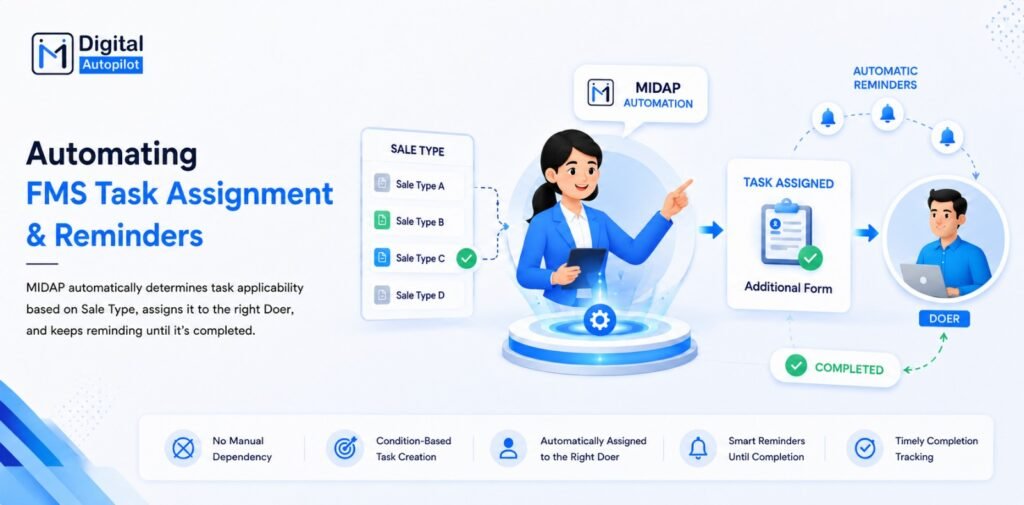
Using MIDAP’s Flow Management System, the workflow was automated based on the Sale Type selected in the process.
When a new FMS entry is created, the system checks whether the selected Sale Type requires the additional form. If the condition is applicable, MIDAP (MI Digital Autopilot) automatically triggers the required task for the concerned Doer.
The Doer receives the task without requiring a separate manual message or follow-up from the team.
The automation also handles reminders. If the Doer does not complete the required form, the system sends reminders according to the defined workflow. Once the task is completed, the reminder cycle stops.
This created a structured flow:
FMS Entry Created → Sale Type Checked → Applicable Task Triggered → Doer Notified → Reminder Sent if Pending → Task Completed
For Sale Types where the additional form is not required, no unnecessary task is triggered.
How the Automated Workflow Improved the Process
The key improvement was the shift from person-dependent follow-up to system-driven task management.
Previously, the team had to remember which entries required additional action and manually contact the concerned Doer. Now, the workflow itself manages this requirement.
The automation ensures that:
- Applicable tasks are generated automatically.
- The concerned Doer receives the task at the right stage.
- Pending tasks do not get easily overlooked.
- Reminders are handled systematically.
- Completed tasks are automatically recognized by the workflow.
- Unnecessary tasks are avoided for non-applicable Sale Types.
This makes the process more consistent, especially when the number of FMS entries increases.
Business Impact
The automation delivered several operational improvements for the client:
Reduced Manual Follow-Ups
The team no longer needs to manually contact the Doer every time an applicable Sale Type entry is created. This saves time and reduces repetitive coordination.
Improved Task Accountability
Since the task is directly assigned to the concerned Doer, responsibility becomes clearer. The workflow makes it easier to track whether the required action has been completed.
Fewer Missed Tasks
Automated reminders reduce the possibility of a pending form being forgotten because of workload, communication gaps, or missed manual follow-ups.
Reduced Process Delays
By ensuring that required forms are completed on time, the workflow helps prevent avoidable delays in subsequent process activities.
Better Process Consistency
The same logic is applied to every applicable FMS entry. The process no longer depends on whether someone remembers to send a message or follow up manually.
Improved Operational Efficiency
The team can focus on higher-value activities instead of repeatedly monitoring and following up on routine tasks.
Result
A previously manual, follow-up-dependent process was transformed into a structured and automated FMS workflow.
Instead of relying on employees to remember when to assign and follow up on an additional form, MIDAP now handles the task trigger, Doer notification, and reminders based on predefined workflow conditions.
This helped the client create a more reliable process where the right task reaches the right person at the right time—and stays visible until it is completed.
The case demonstrates how targeted FMS automation can eliminate repetitive coordination, improve accountability, and make day-to-day business processes more dependable.